If you live in Longwood and you’re thinking, “What should I actually be doing for HVAC maintenance right now?” you’re not alone—and most generic checklists won’t help much here. In Central Florida, I’ve seen the same issues pop up again and again: drain lines that slime up fast, coils that stay damp and collect grime, and “it’s cooling but feels sticky” complaints that trace back to small maintenance misses—not major failures.
That’s why this page isn’t a one-size-fits-all schedule. It’s a month-by-month, Longwood-specific HVAC maintenance checklist built around what tends to break (and what quietly drives up power bills) in a hot, humid, storm-prone climate. You’ll get calendar-ready tasks you can do in minutes, plus practical “watch for this” cues—like when a musty smell usually signals moisture buildup vs. a simple filter problem—and clear guidance on which months are smartest for professional tune-ups. The payoff: more stable comfort, better humidity control, fewer surprise no-cool calls, and a system that lasts longer because you’re maintaining it like a Floridian—not like a generic homeowner guide.
TL;DR Quick Answer
In Longwood’s hot-humid climate, HVAC maintenance is mostly about airflow + moisture control—not just “keeping it running.”
Do this to stay ahead of breakdowns and high bills:
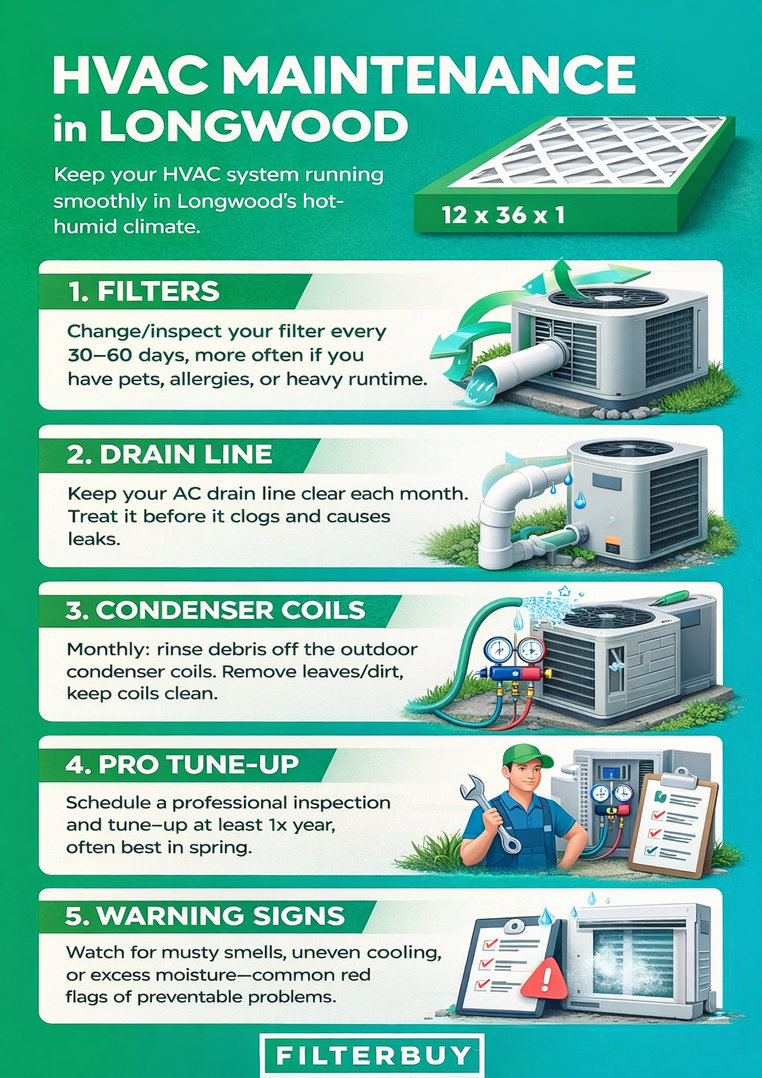
Change/inspect your filter every 30–60 days (more often with pets, allergies, or heavy runtime).
Keep the condensate drain line clear (monthly check; treat it before it clogs and leaks).
Rinse debris off the
Top Takeaways
Filters, coils, drain line.
Month-by-month beats once-a-year.
Small misses stack up in peak heat.
Get at least 1 pro tune-up yearly.
Best timing: spring.
Add fall if heavy runtime or past drain/humidity issues.
Know the early warning signs.
Cool but clammy.
Musty smell.
Weak airflow.
Short cycling.
Water stains/leaks.
Use trusted references before you pay.
Seminole permits.
FL DBPR license check.
ENERGY STAR + CDC guidance.
Longwood’s HVAC systems work hard most of the year because they’re not only cooling—they’re pulling humidity out of your home. That’s why the most common “surprise” problems here usually come from two things: restricted airflow (filters/coils) and condensate drainage issues (drain line/pan). This month-by-month checklist keeps you ahead of both.
Month-by-month HVAC maintenance checklist (Longwood, FL)
January–February (Cooler weeks / low-to-moderate runtime)
Replace or inspect the air filter.
Run heat mode once to confirm your heat pump is working.
Check for new noises or vibrations (early signs of wear).
March–April (Best time for a pro tune-up)
Schedule a professional maintenance visit before peak heat.
Clear leaves and debris around the outdoor unit (give it breathing room).
Watch for early humidity issues (“cool but clammy”).
May–June (Humidity climbs / drain-line season)
Check the condensate drain line and overflow pan for slow drainage or water staining.
Confirm airflow feels strong at vents (weak airflow often starts small).
Lightly rinse debris off the outdoor unit fins (gentle hose only).
July–August (Peak strain months)
Replace the air filter more frequently if needed (pets/allergies/high runtime).
Watch for red flags: musty smell, short cycling, rising bills, uneven cooling.
If you’ve had past clogs, do a quick drain-line check monthly.
September–October (Storm season + post-summer wear)
After outages, make sure the system restarts normally and drains properly.
Consider a fall tune-up if summer was rough or comfort was uneven.
November–December (Transition + reset)
Test heat mode again and replace the filter.
Do a quick end-of-year check: water stains near the air handler, musty smells, airflow changes.
What a “real” tune-up should include
A good maintenance visit typically checks: electrical components, refrigerant performance indicators, condensate drain/float switch, coil condition, airflow, and thermostat operation.
Quick rule of thumb
If you only remember two things in Longwood:
Protect airflow (filter + coil cleanliness)
Protect drainage (condensate line + pan)
Those two habits prevent most avoidable breakdowns, leaks, and “sticky house” complaints in Central Florida.
Essential Resources
Seminole County Permits & Inspections: Know What’s Required Before Major HVAC Work
If maintenance turns into a system replacement or significant repair, this is where you confirm permit requirements, inspection steps, and local compliance—so there are no last-minute surprises.
URL: https://www.seminolecountyfl.gov/departments-services/development-services/building/
Florida DBPR License Lookup: Verify You’re Working With a Properly Licensed Contractor
Before you approve repairs or commit to a service plan, quickly confirm the provider’s license status and public record through Florida’s official database.
URL: https://www.myfloridalicense.com/wl11.asp
ENERGY STAR HVAC Maintenance Checklist: Benchmark What a Thorough Tune-Up Should Cover
Use this as a simple standard to compare service offerings and ensure the visit includes the basics that protect performance—filters, coils, airflow, and system checks.
URL: https://www.energystar.gov/saveathome/heating-cooling/maintenance-checklist
EPA Section 608 Refrigerant Rules: Understand What’s Regulated (and Why It Matters)
If refrigerant is mentioned, this explains who is allowed to handle it and what compliant service should look like, helping you avoid risky shortcuts.
URL: https://www.epa.gov/section608/regulatory-updates-section-608-refrigerant-management-regulations
ACCA Homeowner Resources: Learn What “Quality HVAC Service” Looks Like
Get clear guidance on professional best practices—especially around airflow, sizing, and humidity control, which are big comfort drivers in Central Florida.
URL: https://www.acca.org/homes
Florida Building Code Online: Sanity-Check Recommendations for Repairs and Replacements
Helpful for homeowners who want to understand the code framework behind installation and upgrade recommendations—particularly when scope expands beyond “routine maintenance.”
URL: https://www.floridabuilding.org/bc/bc_default.aspx
Duke Energy Florida Rebates: Check Incentives If Maintenance Points Toward an Upgrade
If your system is struggling or nearing replacement age, this is where you can review current rebate options that may reduce your out-of-pocket cost.
URL: https://www.duke-energy.com/Home/Products/Home-Energy-Improvement/HVAC-Replacement?jur=FL01
Supporting Statistics
Airflow restrictions can waste ~15% of your cooling energy
ENERGY STAR notes that replacing a dirty, clogged filter can lower AC energy use by up to 15%.
What I see this look like: “It’s running longer than usual” + “My bill spiked” + “Airflow feels weaker.”
Why it supports this checklist: consistent filter + airflow checks are a monthly habit, not a once-a-year task.
Source (U.S. EPA / ENERGY STAR): https://www.energystar.gov/saveathome/heating-cooling/maintenance-checklist
Duct sealing/insulation can deliver ~20%+ efficiency gains
ENERGY STAR reports sealing and insulating ducts can improve heating/cooling efficiency by as much as 20% (or more).
What I see this look like: one “always warm” room, uneven airflow, or “sticky” comfort even when the thermostat reads cold.
Why it supports this checklist: maintenance should include periodic comfort/airflow red-flag checks (not just equipment checks).
Source (U.S. EPA / ENERGY STAR): https://www.energystar.gov/saveathome/heating-cooling
Indoor humidity guidance: aim for ~30–50%
CDC recommends keeping indoor relative humidity around 30–50%.
What I see this look like in Florida: “cool but clammy” complaints that trace back to drain line, coil moisture, or airflow issues.
Why it supports this checklist: monthly drain/condensate awareness helps prevent the most common moisture-related problems.
Source (CDC): https://www.cdc.gov/asthma/media/pdfs/2024/06/home_assess_checklist_P.pdf
Most U.S. homes rely on AC—maintenance is mainstream
U.S. DOE notes 88% of U.S. homes have air conditioning; 66% have central AC.
Why it supports this checklist: if your home depends on AC, preventive care is one of the simplest ways to reduce breakdown risk.
Source (U.S. DOE): https://www.energy.gov/energysaver/air-conditioning
Final Thought & Opinion
HVAC maintenance in Longwood isn’t a once-a-year task. It’s a monthly rhythm that protects comfort, humidity control, and repair budgets.
What this page gives you
A month-by-month homeowner checklist for Longwood, FL
Clear “do this now” tasks: filters, airflow checks, coil awareness, drain/condensate care
Trusted next-step resources for:
permits/inspections
license verification
maintenance standards
rebates
What the data supports
Dirty, clogged filters can increase AC energy use—replacing them can cut energy use by up to ~15% (ENERGY STAR).
Duct sealing/insulation can improve efficiency by ~20%+ (ENERGY STAR).
Indoor humidity guidance: ~30–50% (CDC).
My opinion (from what I’ve consistently seen in real homes)
Most “emergency” AC calls in Central Florida are predictable, not random. They usually start small:
A drain line slowly sludges up
A filter gets pushed “one more week”
A damp coil collects grime
Airflow drops—then runtime and bills rise
The system finally fails during peak heat
The simplest rule to follow
If you do nothing else, focus on two non-negotiables:
Airflow (filters + returns + coil cleanliness)
Water management (drain line + pan + float switch awareness)
Small habits here prevent the biggest headaches later—especially in Longwood’s hot, humid, long cooling season.
FAQ on “HVAC Maintenance in Longwood”
Q: How often do Longwood homeowners need HVAC maintenance?
A:
Minimum: 1 pro tune-up/year
Best timing: Spring (Mar–Apr)
Add fall if: heavy summer runtime, humidity problems, prior drain clogs
Q: How often should I change my AC filter in Longwood?
A:
Every 30–60 days
Go 30 days if: pets, allergies, renovations, high runtime
Why: airflow drops quickly → longer runtimes + higher bills
Q: Why do AC drain lines clog so often here?
A:
Hot-humid weather = more condensation
Buildup forms over time → backup → leaks/shutdowns
Do: monthly drain-line check (don’t wait for water)
Q: What are the early warning signs I’m overdue?
A: Look for:
Cool but clammy rooms
Musty smell
Weak airflow
Short cycling
Bill spikes
Water stains/leaks near the air handler
Q: Do I need a permit for HVAC work in Longwood?
A:
No for routine maintenance
Often yes for: replacement, major equipment changes
Check: Seminole County permits/inspections before work starts
Learn more about HVAC Care from one of our HVAC solutions branches…
Filterbuy HVAC Solutions - Miami FL - Air Conditioning Service
1300 S Miami Ave Apt 4806 Miami FL 33130
(305) 306-5027
Filterbuy HVAC Solutions - Miami FL - Air Conditioning Service